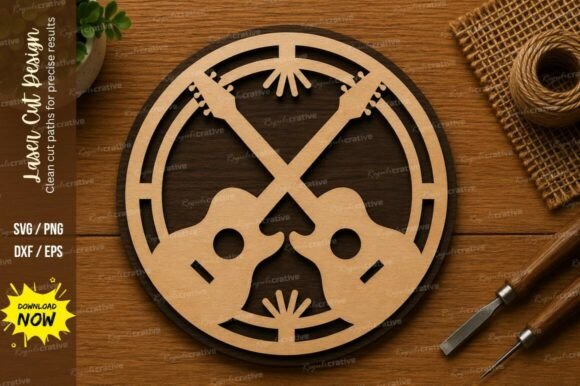
Crossed Guitar SVG Music Instrument: A Guide to Precision Laser Cutting and Design
Music has a unique way of transcending language, and for creators who work with wood, acrylic, or metal, capturing that essence in physical form is a rewarding challenge. The Crossed Guitar SVG Music Instrument design has become a staple in the maker community, appearing on everything from boutique shop signage to personalized wedding gifts. However, simply downloading a file and sending it to your laser cutter does not guarantee a professional result. Many enthusiasts and small business owners overlook the technical nuances of vector preparation, leading to wasted materials and frustrated customers.
Understanding the difference between a basic image and a premium quality laser cutting design file set is crucial. This guide explores common pitfalls when working with guitar-themed vector graphics and provides practical advice to ensure your projects are smooth, precise, and commercially viable.
The Hidden Complexity of Vector Files
One of the most frequent mistakes beginners make is assuming all digital files are created equal. You might find a free PNG online and assume it will cut cleanly. In reality, raster images like PNGs rely on pixels, which can result in jagged edges when scaled up or interpreted by CNC machinery. A true Crossed Guitar SVG Music Instrument design must be vector-based. Vectors use mathematical paths rather than pixels, allowing you to resize the design infinitely without losing quality. This is non-negotiable for professional results.
When evaluating a design package, look for versatility. A premium set should include multiple formats such as SVG, EPS, PNG, DXF, and PDF. Each format serves a specific purpose. SVG is ideal for web-based cutting software like Cricut Design Space or Silhouette Studio. DXF is often preferred for industrial CAD programs and older laser controllers. EPS allows for advanced editing in Adobe Illustrator, while PDF provides a quick preview and standard printing option. If a seller only provides one format, you may find yourself limited by your software’s compatibility, forcing you to use unreliable online converters that can corrupt path data.
Avoiding Common Cutting Errors
Even with the right file format, poor node management can ruin a project. Laser cutters follow paths defined by nodes and anchors. Low-quality designs often have excessive nodes, causing the laser head to stutter or pause unnecessarily. This not only increases cutting time but can also lead to burn marks on delicate materials like paper or thin acrylic. A well-prepared Crossed Guitar SVG Music Instrument file features clean, optimized vectors with minimal anchor points, ensuring smooth and precise cutting.
Another overlooked detail is the separation of cut lines and engrave areas. In a complex design involving crossed guitars, you may want the outline cut out while the strings or sound holes are engraved. Amateur files often lump these elements into a single layer. Before sending your file to the machine, check your design software to ensure that cut paths and engrave fills are on separate layers or assigned different colors. This simple step prevents the laser from trying to cut through an area meant only for surface marking, saving both time and material.
Material Considerations and Design Integrity
The choice of material significantly impacts how your design performs. What looks perfect on a screen may fail in practice if the structural integrity of the design is not considered. For instance, if you are cutting a large wooden sign using a Crossed Guitar SVG Music Instrument template, pay attention to the thickness of the lines. Thin connections between the guitars and any surrounding text or border can snap during handling or installation.
For DIY projects involving wood or acrylic, ensure that the design accounts for kerf—the width of the material removed by the laser beam. While this is less critical for decorative items, it becomes vital if you are assembling parts that need to fit together, such as a multi-layered 3D wall art piece. Always perform a test cut on scrap material. This allows you to adjust power and speed settings without risking your final piece. It also helps you verify that small details, like the tuning pegs or bridge of the guitar, are not too intricate for your specific machine’s resolution.
Compatibility and Software Workflow
Not all laser CNC machines interpret files in the same way. Hobbyist diode lasers often pair with LightBurn or GRBL controllers, while CO2 lasers might use RDWorks or proprietary software. A major advantage of purchasing a comprehensive package is compatibility. By having access to DXF and EPS files, you can open the design in professional vector editors like CorelDRAW or Inkscape to make necessary adjustments before importing it into your machine’s control software.
Many users struggle because they try to edit SVGs directly in basic viewers. Instead, use a vector editor to inspect the paths. Check for open paths or overlapping lines that could cause the laser to double-cut an area, resulting in excessive charring. Cleaning up these errors beforehand ensures a cleaner finish and extends the life of your laser lens by reducing unnecessary smoke and debris.
Maximizing Value for Small Businesses
For entrepreneurs and freelancers, time is money. An instant download that is ready to use eliminates the hours spent designing from scratch. However, "ready to use" should not mean "uneditable." The best designs allow for customization. You might want to add a band name, a date, or a quote beneath the crossed guitars. Ensure the font used in the design is either included or easily replaceable with standard system fonts to avoid licensing issues.
Furthermore, consider the end-use of your product. If you are creating jewelry from metal or paper, the scale of the Crossed Guitar SVG Music Instrument must be adjusted accordingly. Because vector files are resolution-independent, you can shrink the design for earrings or expand it for a door sign without pixelation. This flexibility is a key selling point for creators who offer personalized items. It allows you to cater to a wider audience without needing multiple design files.
Final Checks Before Production
Before committing to a full production run, take a moment to review your setup. Verify that your material is flat and securely held in place. Warped wood can shift during cutting, ruining the alignment of the crossed guitars. Additionally, ensure your focus is set correctly for the material thickness. A slight misalignment in focus can result in uneven cuts, where one side is clean and the other is ragged.
By choosing a high-quality, multi-format design package and paying attention to these technical details, you elevate your craft from amateur hobbyist to professional creator. The Crossed Guitar SVG Music Instrument is more than just a graphic; it is a tool for expression. Treat it with the care it deserves, and your finished pieces will reflect the precision and passion inherent in both music and making.