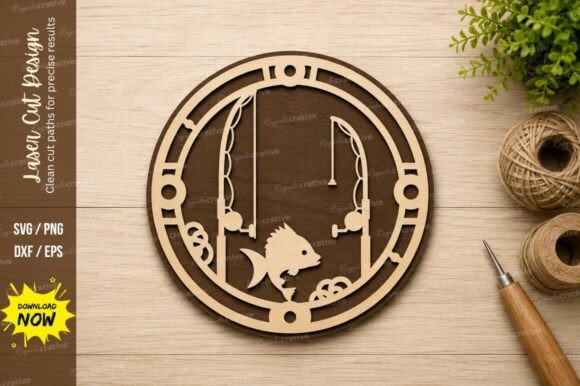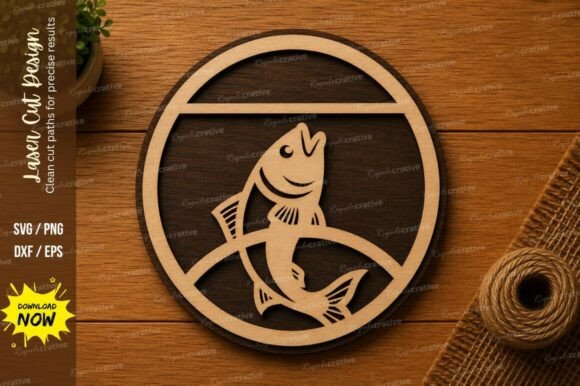
Mastering Precision: The Jumping Fish Circle SVG Fishing Laser Design for Modern Makers
In the evolving landscape of digital fabrication, the intersection of artistic creativity and technical precision defines the quality of the final product. For hobbyists, professional designers, and small business owners utilizing laser cutting technology, the source file is as critical as the machine itself. A poorly constructed vector can lead to burnt edges, incomplete cuts, and wasted materials. This is where a specialized asset like the Jumping Fish Circle SVG Fishing Laser design becomes an invaluable resource. It represents more than just a graphic; it is a meticulously engineered tool designed to streamline the workflow from concept to physical object.
The demand for high-quality, ready-to-cut designs has surged as laser cutters become more accessible to the general public. However, accessibility often brings the challenge of finding files that are truly optimized for CNC (Computer Numerical Control) processes. Many free or low-quality downloads contain redundant nodes, open paths, or non-scalable raster elements that frustrate users. In contrast, a premium quality laser cutting design file set offers a solution by providing clean, closed vectors that ensure smooth operation across various hardware platforms.
The Technical Advantage of Multi-Format Compatibility
One of the most significant hurdles in digital fabrication is software incompatibility. Different laser cutting machines and design programs prefer specific file types. A robust design package addresses this by offering a comprehensive suite of formats, ensuring that regardless of your setup, you can proceed without conversion errors. The inclusion of SVG, EPS, PNG, DXF, and PDF files in a single package is not merely a convenience; it is a necessity for a seamless user experience.
- SVG (Scalable Vector Graphics): This is the gold standard for web-based design software and many modern laser controllers. It allows for infinite scalability without pixelation, ensuring that whether you are cutting a small keychain or a large wall decoration, the lines remain crisp.
- DXF (Drawing Exchange Format): Preferred by users of AutoCAD and industrial-grade CNC software, DXF files provide precise geometric data that older or more specialized machinery often requires.
- EPS (Encapsulated PostScript): Ideal for professional graphic designers using Adobe Illustrator or CorelDRAW, EPS files maintain vector integrity while allowing for easy integration into larger composite designs.
- PDF (Portable Document Format): Useful for quick previews, printing templates, or importing into software that may not natively support SVG or DXF.
- PNG (Portable Network Graphics): While raster-based, high-resolution PNGs are included for reference, sublimation printing, or use in software that relies on image tracing, though vector formats are always recommended for cutting.
This versatility means that the Jumping Fish Circle SVG Fishing Laser design is not locked into a single ecosystem. Whether you are using a Glowforge, xTool, Epilog, or a generic diode laser with LightBurn or LaserGRBL, the file will integrate smoothly into your workflow.
Design Integrity and Vector Optimization
The core value of any laser cut file lies in its vector construction. A "clean" vector design implies that all paths are closed, there are no overlapping lines that could cause the laser to burn the same area twice, and the nodes are optimized to reduce machine processing time. When working with intricate designs such as a circular motif featuring jumping fish, the complexity of the curves can pose challenges if the file is not properly prepared.
Premium design sets undergo rigorous testing to ensure that every curve and angle is calculated for optimal laser pathing. This results in faster cutting times and reduced wear on the laser tube or diode. For the end-user, this translates to efficiency. You spend less time troubleshooting software errors and more time creating. The ability to resize the design easily without losing quality is a direct benefit of true vector architecture. Unlike raster images, which become blurry when enlarged, vector paths recalculate mathematically, maintaining perfect sharpness at any dimension.
Material Versatility and Application Scenarios
The utility of the Jumping Fish Circle SVG Fishing Laser extends across a wide spectrum of materials, each offering unique aesthetic and functional possibilities. Understanding how this design interacts with different substrates can inspire diverse projects for creators and educators alike.
Wood and Plywood Projects
Wood remains the most popular medium for laser cutting due to its natural beauty and ease of use. When cutting this fish circle design from birch plywood or basswood, the clean vectors ensure that the delicate fins and circular borders do not char excessively. This makes it ideal for creating rustic home decor, such as wall hangings, coasters, or ornamental frames. The organic nature of wood complements the aquatic theme, adding warmth to the geometric precision of the circle.
Acrylic and Modern Decor
For a more contemporary look, acrylic offers a sleek, polished finish. Cutting the design from colored or clear acrylic allows light to pass through, making it suitable for lampshades, window suncatchers, or layered 3D art pieces. The precision of the DXF and SVG files ensures that the edges melt smoothly, resulting in a flame-polished look that requires minimal post-processing. This is particularly relevant for business owners creating custom signage or retail displays.
Paper and Cardstock Crafts
Educators and paper craft enthusiasts can utilize the PDF or SVG formats to create intricate greeting cards, invitations, or educational tools. The design’s circular symmetry makes it perfect for mandala-style paper cuts or decorative overlays. Because the file is scalable, teachers can adjust the size to fit standard cardstock dimensions, facilitating classroom activities that combine art with geometry lessons.
Metal Engraving and Marking
While cutting thick metal requires high-powered industrial lasers, many desktop lasers can engrave coated metals or anodized aluminum. The high-contrast lines of the Jumping Fish Circle SVG Fishing Laser design translate well to engraving, allowing for the creation of durable tags, jewelry components, or personalized gifts. The vector precision ensures that fine details remain visible even on hard surfaces.
Empowering DIY Culture and Small Business Growth
The rise of the maker movement has democratized manufacturing, allowing individuals to produce professional-grade goods from home. However, the bottleneck often lies in design capability. Not every crafter is a skilled graphic designer capable of creating complex vector art from scratch. Access to a premium, pre-optimized design file bridges this gap, enabling creators to focus on production, marketing, and customization rather than struggling with Bézier curves and node editing.
For small business owners, time is money. An instant download model means that once a purchase is made, production can begin immediately. There is no waiting for shipping or dealing with physical templates. This immediacy supports rapid prototyping and quick turnaround times for customer orders. Furthermore, the reliability of the file reduces material waste, a crucial factor in maintaining healthy profit margins. When a file cuts correctly the first time, the cost per unit decreases, and customer satisfaction increases due to consistent quality.
Considerations for Optimal Results
While a high-quality file like the Jumping Fish Circle SVG Fishing Laser set provides a strong foundation, achieving the best results also depends on machine calibration and material selection. Users should always perform test cuts on scrap material to determine the ideal power and speed settings for their specific laser module. Additionally, ensuring that the material is flat and securely held in place prevents shifting during the cutting process, which can distort even the most perfect vector design.
It is also important to consider the kerf—the width of the cut made by the laser. In intricate designs, accounting for kerf can be essential if pieces need to fit together tightly. Since the provided files are clean vectors, users can easily offset paths in their design software if compensation for kerf is necessary for assembly projects.
In conclusion, the integration of a professionally prepared, multi-format design file into your creative toolkit enhances both the efficiency and quality of your laser cutting projects. By leveraging the technical strengths of SVG, DXF, and other formats, makers can unlock the full potential of their equipment, producing stunning, precise, and marketable items with confidence.