Hydrological Cycle Board Laser Cut CNC: An Evaluation for Educators and DIY Enthusiasts
The intersection of digital fabrication and educational pedagogy has created new opportunities for hands-on learning tools. Among these resources, the Hydrological Cycle Board Laser Cut CNC stands out as a specialized asset for educators, parents, and makers interested in creating tangible science models. This digital product is not a physical item but a design file intended for use with laser cutting machines such as Glowforge, xTool, or similar CNC devices. It allows users to fabricate a three-dimensional representation of the water cycle, serving as both an educational puzzle and a decorative piece for preschool classrooms or home learning environments.
For those considering integrating this tool into their curriculum or maker projects, it is essential to understand its technical requirements, educational value, and practical limitations. This evaluation explores whether the Hydrological Cycle Board aligns with your specific goals, offering insights into its utility as a Montessori-inspired science toy and a weather station learning aid.
Understanding the Product and Its Components
The core of this offering is a digital archive containing vector and raster files designed for precision cutting and engraving. Typically, the package includes SVG, EPS, PNG, PDF, and DXF formats. This variety ensures compatibility with a wide range of software ecosystems, from proprietary browser-based interfaces to professional-grade design programs like Adobe Illustrator or CorelDRAW. The design is optimized for 3mm plywood, a standard material thickness that balances durability with ease of handling for young learners.
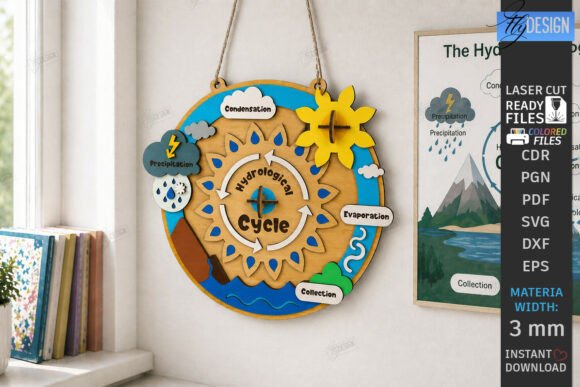
The visual logic of the board relies on a clear distinction between processing instructions. Users are instructed to follow a specific color code: red lines indicate where the laser should cut through the material, black lines denote engraving paths for surface details, and other markings may guide assembly. This structured approach minimizes errors during the fabrication process, provided the user verifies compatibility with their specific machine’s software. The resulting product is a layered diagram that visually demonstrates evaporation, condensation, precipitation, and collection, transforming abstract meteorological concepts into a tactile experience.
Educational Value and Pedagogical Fit
The primary appeal of the Hydrological Cycle Board Laser Cut CNC lies in its alignment with constructivist learning theories, particularly the Montessori method. By engaging with a physical puzzle, children can manipulate the components of the water cycle, reinforcing memory retention through kinesthetic activity. Unlike static posters or two-dimensional textbook diagrams, this board invites interaction. Students can trace the path of water vapor rising from oceans, forming clouds, and returning as rain, thereby internalizing the continuous nature of the hydrological process.
This tool is particularly effective for visual and tactile learners who struggle with abstract scientific explanations. In a preschool or early elementary classroom, the board serves as a focal point for discussions about weather patterns and environmental science. It transforms complex terminology into accessible visual cues. Furthermore, the DIY aspect allows educators to customize the finish, paint, or labeling of the board, tailoring it to specific lesson plans or language requirements. This flexibility makes it a versatile asset for diverse educational settings, from homeschooling units to formal school science projects.
Technical Considerations and Fabrication Requirements
While the educational benefits are significant, prospective users must assess their technical capacity to utilize this digital product effectively. Owning a laser cutter is a prerequisite. Machines like the Glowforge have simplified the entry barrier for hobbyists, but they still require a learning curve regarding power settings, speed adjustments, and material calibration. Users must ensure their machine can handle 3mm plywood without excessive charring or incomplete cuts. Additionally, the quality of the final product depends heavily on the source material; high-quality, void-free plywood yields cleaner edges and a more professional appearance.
File compatibility is another critical factor. Although the archive includes multiple formats, users must confirm that their software can interpret SVG or DXF files correctly. Issues with scaling or line recognition can lead to wasted material and frustration. It is advisable to perform test cuts on scrap wood before committing to the final piece. Moreover, the instruction to "RED line – CUT BLACK line – ENGRAVE" must be strictly followed within the software interface. Misinterpreting these commands can result in a board that falls apart or lacks necessary textual labels, diminishing its educational utility.
Tradeoffs and Limitations
As with any specialized educational tool, there are tradeoffs to consider. The most obvious is the initial investment in hardware. For individuals or schools without access to a laser cutter, the cost of purchasing or renting equipment may outweigh the benefit of a single puzzle board. In such cases, pre-made plastic or cardboard alternatives might be more economical, despite lacking the aesthetic and durability advantages of wood.
Additionally, the assembly process requires time and attention to detail. Gluing layered plywood pieces demands precision to ensure that moving parts, if any, function smoothly and that the structural integrity remains intact. For busy educators, the time commitment involved in fabrication and assembly might be a deterrent compared to off-the-shelf educational kits. However, for those who view the creation process as part of the learning experience—perhaps involving older students in the manufacturing phase—this limitation becomes an additional educational opportunity.
Situations Where This Tool Is a Strong Fit
The Hydrological Cycle Board Laser Cut CNC is an ideal choice for several specific scenarios. First, it suits makerspaces and STEM labs where students are encouraged to engage with digital fabrication tools. Here, the board serves as a project that combines science content with engineering skills. Second, it is well-suited for Montessori classrooms that prioritize natural materials and hands-on exploration. The wooden texture and tactile nature of the puzzle align perfectly with these pedagogical values.
Third, homeschooling families seeking to create a rich, multi-sensory learning environment will find this tool valuable. It allows for customization that mass-produced toys cannot offer, enabling parents to integrate the board into broader thematic units on weather, geography, or environmental stewardship. Finally, it serves as an excellent decorative element for science centers or libraries, providing an aesthetically pleasing yet informative display that invites curiosity.
When to Consider Alternatives
Conversely, there are situations where alternative resources may be more appropriate. If the goal is immediate deployment with zero preparation time, pre-assembled plastic models or printed worksheets are more efficient. For institutions with limited budgets and no access to fabrication tools, the barrier to entry is too high. Additionally, if the target audience consists of very young children who may mouth objects, untreated wood may pose safety concerns unless properly sealed and finished, adding another step to the production process.
Digital-only products also lack the instant gratification of physical goods. Users must wait for delivery of materials and invest labor in creation. Those seeking a quick fix for a lesson plan may find the workflow cumbersome. In these instances, traditional teaching aids or subscription-based educational kits might provide a more streamlined solution.
Making the Decision
Deciding whether to purchase the Hydrological Cycle Board Laser Cut CNC depends on your resources and educational philosophy. If you possess a laser cutter, value natural materials, and seek to deepen student engagement through tactile learning, this digital file offers substantial value. It provides a flexible, durable, and visually appealing tool that supports science literacy. However, if you lack the necessary equipment or prefer ready-to-use solutions, the investment of time and effort may not yield the desired return.
Ultimately, this product bridges the gap between digital design and physical education. It empowers creators to produce high-quality, customized learning aids that stand out in both form and function. By carefully evaluating your technical capabilities and instructional needs, you can determine if this hydrological cycle board is the right addition to your educational toolkit.